Built for Uptime: How PBSC Transfer Hatches Support Cleanroom Reliability
Why Uptime Matters: Operational and Financial Risks
Pharmaceutical labs and manufacturing sites face serious risk from unplanned downtime – interruptions that stop production, raise costs and jeopardize product integrity. Even short outages can idle personnel, spoil materials, or delay the release of time-sensitive batches. Industry figures illustrate the scale of the problem,
- 73% of lab professionals identify unplanned downtime as a leading barrier to productivity.
- 60% of laboratories experience significant downtime due to equipment failures, missed calibrations, or asset location issues [1].
These events can cut operational capacity by more than 10% in mid-to-large labs [2], driving higher labor costs, emergency repairs and compromised batch quality.
Regulatory Drivers: EU GMP Annex 1 and FDA Guidance
Regulatory guidance reinforces the importance of reducing contamination risk. The revised EU GMP Annex 1 (2023) mandates pass-through hatches with interlocked doors to protect higher-grade environments and preserve pressure differentials in aseptic areas. Sections 4.14–4.15 call out interlocks and active air flushing where needed. The FDA’s aseptic processing guidance similarly stresses validated environmental controls and interlocked airlocks to reduce contamination risk and avoid costly reworks or rejected batches.
Designed to Support Operations During Power Loss
Addressing these challenges requires equipment that combines reliability with an effective preventive maintenance program. PBSC transfer hatches are engineered to support critical operations – including protection during power loss.
Passive Mechanical Interlocks: Durable, Fail-Safe Protection
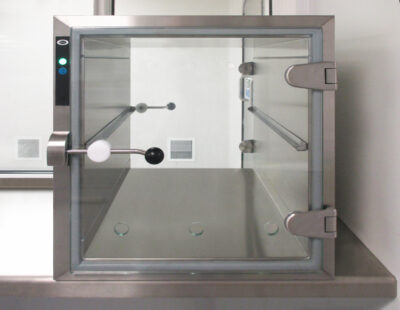
PBSC’s mechanical interlock sits between two hatch skins and operates fully without power. This passive, fail-safe approach provides continuous protection even during outages. The enclosed mechanism reduces the risk of accidental or unauthorized tampering and enforces strict sequential door use, helping to preserve cleanroom pressure cascades and area segregation. Its sturdy, low-maintenance design reduces the chance of unexpected failures while helping meet regulatory expectations and supporting uptime.
Electronic Control Options: Enhanced Flexibility with Automation
For facilities that need automation, PBSC’s electronic interlock systems add flexibility. The control panel supports adjustable time delays for purge cycles, UV disinfection or pressure stabilization and includes visual indicators on both sides for quick status checks. Systems can integrate with Building Management Systems (BMS), fitting validated workflows typical in pharmaceutical, biotech and high-containment settings. This automation supports repeatable performance and regulatory traceability.
Proactive Maintenance: The Key to Minimizing Downtime
Even with robust equipment, a planned preventive maintenance program is critical to reduce the risk of unplanned downtime. Research shows that structured maintenance programs lower failure rates, extend uptime and improve audit readiness.
PBSC’s service packages include regular inspections, calibration and performance testing to keep your hatches compliant and operating reliably. Protect your cleanroom – and your productivity – by partnering with PBSC for proactive maintenance.
PBSC Planned Preventive Maintenance

Learn more about our maintenance and servicing options
PBSC Planned Preventive Maintenance
[1] M. Filbin et al, Critical Care Medicine 2018; 46:1592–1599, Editorial Team. Consequences of Unplanned Downtime in the Laboratory, Beckman Coulter Diagnostics. Beckman Coulter. Published 2021 February.
[2] Pharmaceutical Technology, “Lab Downtime Impacts and Mitigation,” 2023.
Disclaimer
This document is provided for general information purposes only. While PBSC designs and supplies high-quality equipment for cleanroom and containment environments, PBSC does not provide regulatory, operational, or compliance advice. For facility-specific guidance or regulatory interpretation, consult a qualified industry advisor or the relevant regulatory body.
- Previous
- Next